


 English
 Español
 عربى
ruled papernoun
- Paper printed with guide lines to support handwriting.
- Another name for lined paper. Pale lines give "feint-ruled" paper.
- Paper that may carry extra vertical lines for a margin, tab stops or a grid.

Ruled paper is paper printed with evenly spaced guide lines, usually horizontal, that help you write in straight, even rows. It is also called lined paper, and when the lines are pale it is often called feint-ruled paper. What changes from one sheet to the next is the gap between the lines and whether there is a margin line, which is how you get wide ruled, college ruled and narrow ruled paper. If you are choosing notebooks for a retail range, the ruling is one of the first specs to settle.
The word "ruled" goes back to how the lines were first made. Paper was ruled by hand, with a ruler and a pointed tool, long before it was printed. A machine for ruling paper was patented in England in 1770, and ruling has been done by machine ever since.
The layout of ruled paper depends on the purpose, the handwriting style and the language, not on the size of the sheet. An A4 pad and an A5 notebook can carry exactly the same ruling. The lines are usually fine and light, so they guide the hand without competing with the ink.
The three names you will see most often describe the distance between lines. Wide ruled leaves the most room for each line of writing, narrow ruled leaves the least, and college ruled sits in between. The swatches below show the difference at roughly the same scale.
11/32 in (8.7 mm)
9/32 in (7.1 mm)
1/4 in (6.4 mm)
5 mm squares
Wide ruled paper is also known as legal ruled. On wide and college ruled sheets, a vertical margin line usually sits about 1.25 in (32 mm) from the left edge, leaving space for notes and corrections.
Spacings differ by region. In the UK and Commonwealth there is no single standard for ruling, but adult ruling is most commonly 8 mm and narrow ruling about 6 mm. Squared maths paper has a 5 mm grid, and French school paper uses a different pattern with heavier vertical lines 8 mm apart. Other ruled paper may use 6, 7, 8 or 9 mm.
| Ruling | Line spacing | Where you see it |
| Wide (legal) ruled | 11/32 in (8.7 mm) | Larger handwriting, legal-style pads |
| College (medium) ruled | 9/32 in (7.1 mm) | Everyday notes for students and adults |
| Narrow ruled | 1/4 in (6.4 mm) | Small handwriting, more lines per page |
| UK adult feint | About 8 mm | General adult pads and notebooks |
| UK narrow feint | About 6 mm | Compact notes |
| Squared (maths) | 5 mm grid | Maths, tables and diagrams |
For product planning, it helps to know that a 7 mm ruling, which is common in notebooks made in Asia, sits very close to the college ruled standard.
Ruled paper is one of several page layouts, and each suits a different way of working. Choosing between them is mostly a question of what the owner will do with the notebook.
Best for writing in sentences. The lines keep text level and the rows even.
Best for tables, graphs and diagrams. Lines run both ways to form squares, and graph paper often bolds every fifth or tenth line.
A lighter structure for planners and bullet journals. Dots guide the page without the visual weight of full lines.
Best for sketching and free layout, with no guide at all.
Many notebook programs do not have to choose one. The same cover and binding can carry ruled, grid or custom pages, which lets a brand serve writers and diagram makers from one design. Our A4 spiral notebook is built this way, with 5 x 5 mm grid, 7 x 7 mm grid and 7 mm ruled options for the inner pages.
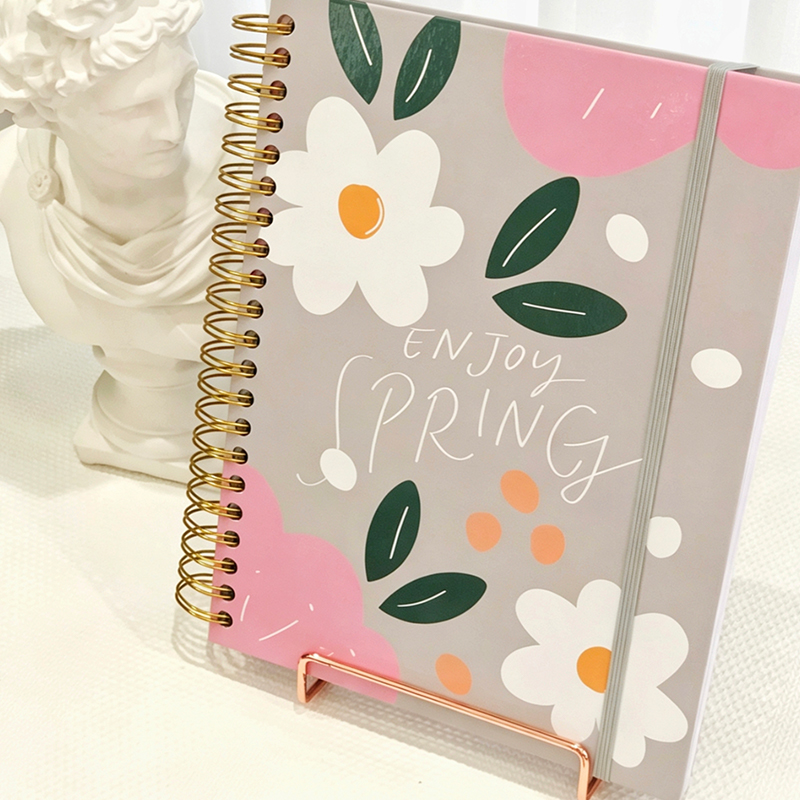
A large-format notebook with a rigid cover, spiral coil binding and an elastic band on the back cover. Because the inner pages come in grid or ruled formats, one cover design can serve note-takers and people who draw tables and diagrams.
Ruling looks like a small detail, but it does four jobs every time someone opens the notebook.
Without a guide, lines of handwriting drift up or down. The rule keeps each row straight.
The gap between lines gives the hand a height to aim for, so letters stay a similar size down the page.
Narrower ruling fits more lines on the same sheet. Wider ruling suits larger handwriting but fits fewer lines.
A margin line leaves room for corrections, page numbers and quick side notes.
Ruled pages work well beyond the school desk. Two of the most common uses in a gift and stationery range are decorative journals and business notebooks, and the ruling does a slightly different job in each.
In a journal, ruled pages give structure without making the book feel like a form. The cover can carry the design, and the pages stay quiet. Paper weight matters more here, because people write with gel and fountain pens, and heavier paper is less likely to show the writing through the back of the sheet.
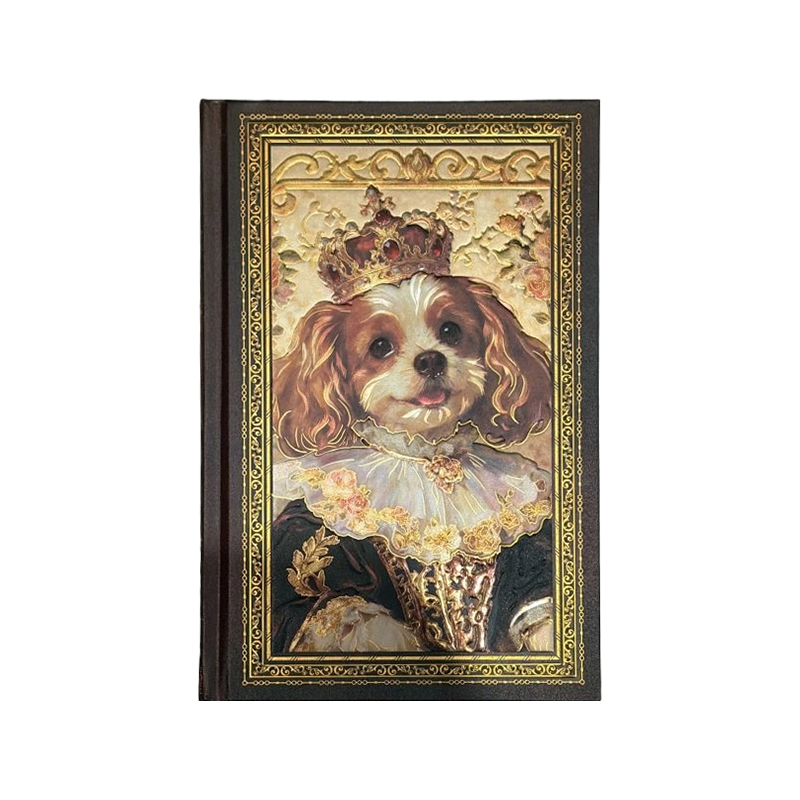
A hardcover journal with a vintage golden embossed frame and golden foil printing around a royal-style pet portrait. The 7 mm ruled pages keep the inside simple, so the cover does the talking. Custom cover colors and sizes are available.
In an office notebook, ruled lines are what make meeting notes and records look orderly. The word "lined" is often used for the same thing, so a lined notebook and a ruled notebook are the same product. A hardcover with a PU leather surface is a common choice for business gifts and corporate orders.
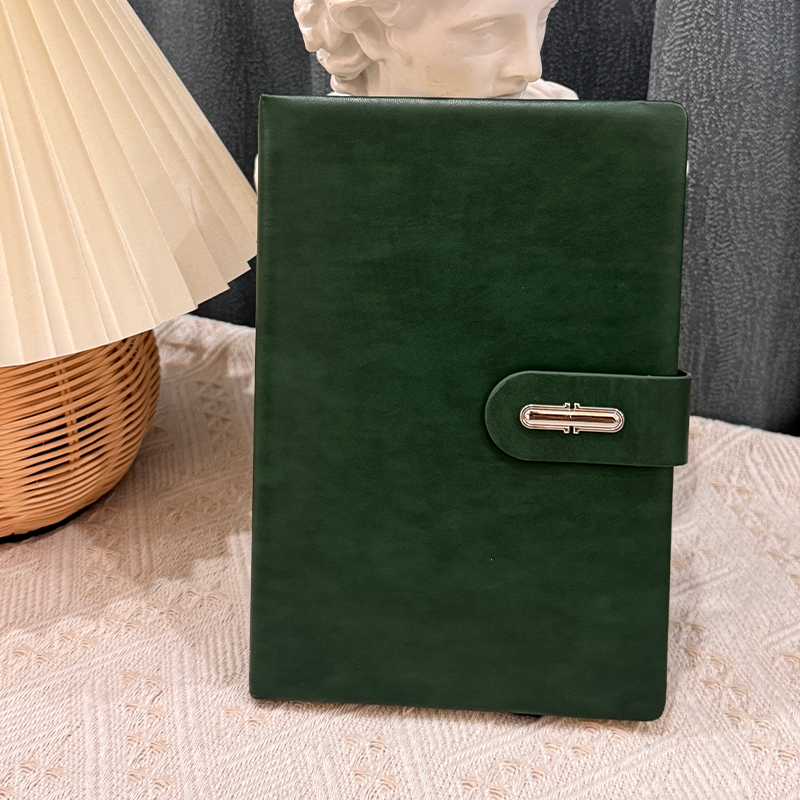
A PU leather hardcover business notebook with a soft vintage-style surface and a minimalist closure. Horizontal ruled pages suit meeting notes and office records, and custom cover colors and sizes are available.
If you are a brand, retailer or importer, the ruling is something you set, not just something you receive. These are the decisions to settle with your supplier before sampling.
| Decision | What to think about | Example from our notebooks |
| Line spacing | Who writes in it, and how large their handwriting is | 7 mm ruled lines |
| Page format | Ruled for writing, grid for tables and diagrams, or a custom layout | 5 x 5 mm grid, 7 x 7 mm grid or 7 mm ruled |
| Paper weight | The pens your customers use, and how much show-through you accept | 75g, 80g or 100g offset paper |
| Page count | Thickness, binding method and target price | 100 or 112 sheets |
| Size | Desk use, carry-around use, or gift sets | A4 or A5, with custom sizes available |
Two more points belong in every brief. First, check whether the paper type, GSM, color and page count can be changed, since they affect both feel and cost. Second, ask for a pre-production sample, so you can write on the pages yourself before mass production.
You do not need a finished design to start. Tell us the size, the page count, the ruling you want and the cover idea, or send a notebook you already like. We can develop a custom cover, choose the inner paper and match the ruling to your customers, and we support OEM and ODM work from drawings or samples.
For the three notebooks above, the minimum order is 2,000 pieces per design, and standard lead time is about 30 to 45 days, confirmed by order quantity and customization. Samples can be checked before mass production.
Browse our spiral notebooks, paper covered notebooks and PU leather notebooks, or contact us with your specification.
If you have any questions or customization needs, please fill out the contact form at the bottom of the page or reach out to us directly — we will respond promptly.
A source factory specializing in the field of deluxe bookbinding and hardcover stationery, with full-process in-house customization and stringent quality control as its core philosophy.
+86-13588689895
HongxiCrafts888@gmail.com
No. 341, Tashan Road, Fotang Town, Yiwu City, Zhejiang Province, China
 China OEM Notebook Manufacturer
ODM Paper Bag Manufacturer
 Previous